
For Students
Welcome to the Stanford Healthcare Innovation Project!

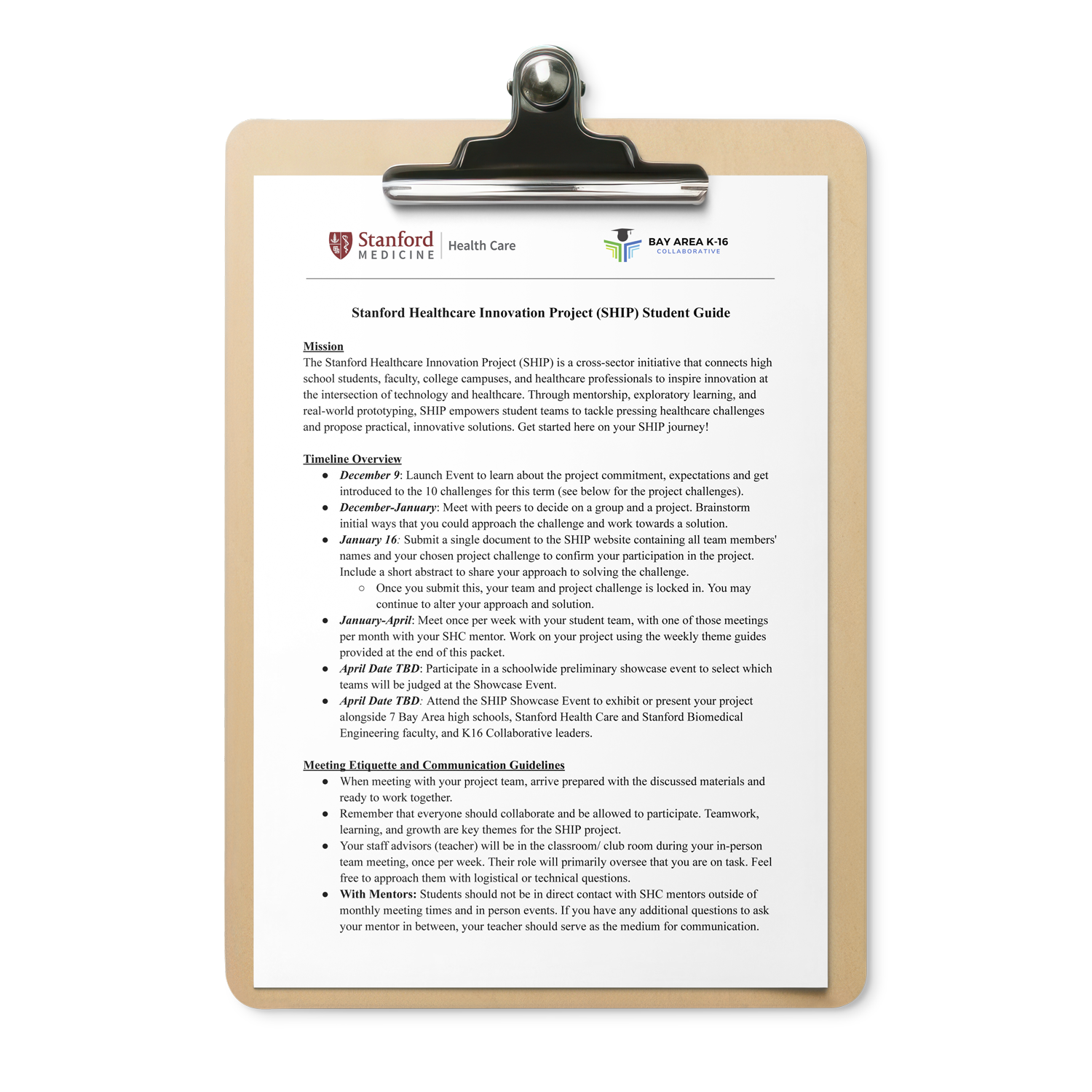
Download the 2025-2026
comprehensive Student Guide.
Updated guide for 2026-2027 will be posted at the
launch event in December.
Key Resources for the 2025-2026 Final Showcase
Get started here on your SHIP journey!
Step 1: Form a Team
LOOK OVER ALL 10 CHALLENGES and identify your top few of interest. Consider ranking all options. Find students with a similar interest as you, since you will form teams based on your project of interest.
Be sure to include members of diverse thought, background, and skillsets in order to have a strong team.
Consider assigning flexible roles [such as organizer, researcher, coder, designer, or engineer leads] and remember that all project elements are collaborative.
Set team agreements such as how to best interact, make decisions, and stay on track.

Step 2: Form an Abstract
An abstract is a short summary of your project idea. It is intended to help you get started in thinking about your project and working as a team. It will also help your mentor understand how best to support you.
Think of the abstract as a project proposal: what problem you’re solving, why it matters, and how you’ll approach it. Walk through some of your next steps, and don’t worry if the challenge isn’t fully solved… that’s what the next 10 weeks are for!

Step 3: Submit your Team and Abstract
Due January 16th, 2026
When you are ready to submit, compile all information into a single document (please use the template!) and upload to the SHIP website submission portal.
If using Google Docs, please download as a PDF before uploading and do not just share a link.

Step 4: Final Presentations
The 10 challenge areas are intentionally broad, open ended concepts. Feel free to interpret the challenge and present your solution in creative ways.
As you enter the final phase, SHIP, it is time to translate your research and prototyping into a professional presentation.
All groups are required to present a physical 24" x 36" poster, which may be supplemented by additional materials (e.g., prototype, computer, or drawing).
This guide is designed to help your team organize your findings and refine your speaking points.
Your goal is to ensure that your technical work is matched by a descriptive visual display and a brief oral pitch that is focused on your team's process.



Explore the 2025-2026 Project Challenge Statements
-
Design a robotic system or device that assists patients in their rehabilitation process, particularly focusing on stroke recovery, physical therapy, or post-surgery rehabilitation.
-
Design a wearable device that continuously monitors vital signs and provides real-time data to healthcare providers, enhancing patient care and early detection of potential issues.
-
Design telemedicine solutions that enable patients to receive hospital-level care at home, focusing on remote monitoring, virtual consultations, and integrating home care with healthcare systems to improve patient outcomes and comfort.
-
Innovate a system or device that reduces the risk of hospital-acquired infections, with a focus on improving sterilization processes or developing antimicrobial surfaces.
-
Create a solution that enhances the security and privacy of patient data in healthcare settings, particularly in the context of increasing digitalization and data sharing.
-
Identify and implement strategies or technologies to streamline Operating Room processes, such as surgical instrument management or automated scheduling, aiming to reduce delays and optimize resource use.
-
This project focuses on developing, including but not limited to tech solutions like smart room controls or communication apps to enhance patient comfort, aiming to make hospital stays more pleasant and supportive.
-
Develop sustainability initiatives in healthcare, such as reducing waste or optimizing energy use, to make healthcare operations more environmentally friendly.
-
Explore AI applications in healthcare, such as predictive analytics or decision support tools, to improve patient outcomes through data analysis and machine learning.
-
Stanford is required to remain compliant with national requirements to ensure patient safety through medical device maintenance. Ensure PM schedules are auto-generated correctly. Flag any devices that are past due or have missed a PM cycle. Predictive metrics to show future PM schedule needs.

The abstract submission period for 2026-2027 will open in December after the launch event.
Timeline
Launch Event
December 2025
- Learn about ten project challenges.
- Website launches with all needed resources to build a team and select a project to work on throughout the Spring.
Team Formation
January 2026
- Teams and abstracts are due on January 16th.
- Groups are paired with Stanford mentors and first meetings take place.
Designing and Prototyping
February 2026
- Teams begin shaping early solution ideas into simple prototypes.
- Monthly mentor meetings support narrowing to one concept and planning next steps.
- Continue steady weekly team work toward building and refining the first version of the project.
Project Development Continues
March 2026
- Teams test early prototypes, learn what works, and make improvements.
- Mentor meetings guide adjustments and help teams strengthen their design.
- Weekly work time focuses on iteration and preparing materials for final presentation development.
Final Student Showcase
April 2026
- Teams finalize prototypes and complete their presentation materials. (All teams must create a physical poster presentation.)
- School choose teams to be judged via preliminary showcase or other method (defer to individual teachers).
- 13 selected teams to present for judging at the culminating event, with all other teams attending to exhibit their work gallery style.
- Final Student Showcase on April 28th from 9AM - 2PM at Alumni Green, Stanford Health Care in Palo Alto
Still have questions?
We’re here to help! If you can’t find what you’re looking for, send us an email at stem@svlg.org, and we’ll get back to you soon.